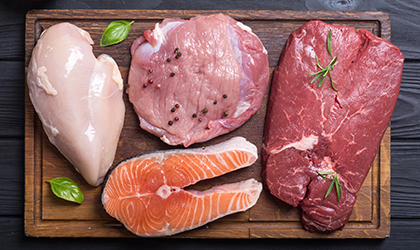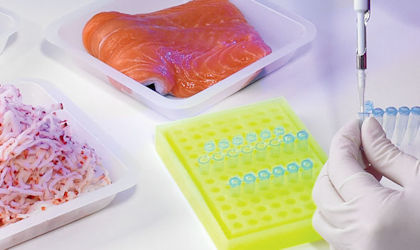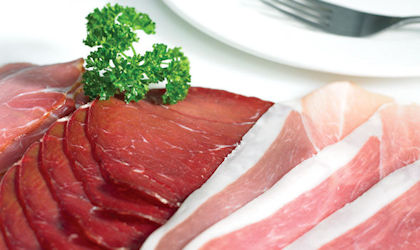

Predicting microbial spoilage of meat Being able to predict the microbial spoilage of meat products will allow manufacturers to assign shelf-lives to such products with increased confidence and speed, and to determine the likely consequences of changes to product formulation. The microbiological shelf-life of many food products is determined using a combination of predictive models and empirical shelf-life trials. Although several mathematical model systems exist for predicting the growth of individual pathogenic organisms, there are far fewer models that look at the overall microbial flora of specific types of foods. Such models would be able to give more useful predictions, as they are based on mixtures of organisms commonly found in these products that may grow, cause spoilage and thus determine the microbial shelf life of the food. We have successfully modelled the effects of temperature, salt, pH and nitrite levels on growth rate of cocktails of microorganisms associated with meat spoilage. Further work has emphasised the importance of allowing for variability in microbial growth when undertaking challenge tests or using mathematical models; of ensuring that sufficient replicates are done; and that recognised uncertainty measurement procedures are instigated. For further information on research or predictive services please: Contact: Gail Betts Campden Laboratory Accreditation Scheme - CLAS
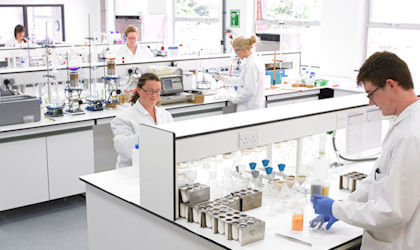
The highly valued CLAS scheme has recently been revised and updated after extensive consultation with industry to ensure that it continues to satisfy the accreditation needs of laboratories and users of laboratory services alike. CLAS is applicable to laboratories undertaking microbiological, chemical, physical, milling, sensory and environmental testing activities within the food, drink, milling, personal hygiene and household products industries and their related sectors. Christina Oscroft, scheme manager, comments CLAS is one of the largest independent laboratory accreditation services in the UK. It provides a practical standard that is achievable for all laboratories, irrespective of size and complexity of operations, and is recognised for the excellent support it provides to participants. Our revised standard has taken account of the new requirements in the international standard, ISO 17025, and those relating to laboratory operations in the revised EFSIS and British Retailer Consortium Technical Standards. Following user feedback, the grading system for reporting non-compliances has been improved to more accurately reflect the nature and significance of problems, and laboratories now have the option to use a CLAS logo to promote their accreditation status. The updates will be implemented from January 2003. For further information please contact Christina Oscroft (+44 (0)1386 842087) New technology toolkit for the baking industry
The first two technology tools in this software product range of useful techniques, equations and methods are being launched in January 2003. They can be used by bakers, product developers and technologists in the food industry to enable efficient processing and product development. Additionally they can be used in training environments. The tools are: Mixing Tool comprising three calculators for heat rise, water temperature and energy input during mixing. Raising Agents Tool for determining quantities and rates of gassing reactions for carbonates and neutralising acids used in baking. The tools come on CD-ROM with context-sensitive help and additional information. Contact: Linda Young Stan Cauvain - ICC President Elect Stan Cauvain, Director of Cereals and Cereal Processing, has just become President Elect of the ICC (International Association for Cereal Science and Technology). He will hold this position for 2 years, assuming the Presidency thereafter. This is the first time that the UK representative has held this prestigious international position in the cereal science world since 1972. New Research projects to be funded from January 2003 A record number of members participated in the annual selection process for new projects to be funded from member subscriptions. Many took advantage of the new facility to record their choices electronically. The twelve selected projects will complement the current research programme and ensure that this continues to meet members stated needs. Raw Materials and Ingredients More efficient transformation of cereals into baked products by understanding the roles of tyrosine cross-links and water during processing. Manufacturing, Packing, Distribution and Supply Pasteurisation: principles, processes and guidelines Forecast: rapid prediction of microbiological shelf-life Modelling vitamin stability in fortified foods and beverages to predict shelf-life Objective measurement of food appearance The application of edible coatings and films in food Antimicrobial surfaces: selection and effectiveness Food and Drink Safety Microbiological methods Industrial microbiological risk assessment Acrylamide: formation in foods Consumer Needs Obtaining quality information from consumers through efficient analysis of consumer data and related improvements to questionnaire design Knowledge Transfer Guidelines for the prevention, control and identification of foreign bodies in food Contact: Steven Walker, Director of Research (Tel: +44 (0)1386 842011) e-mail: research@campden.co.uk Hair as a foreign body
Prevention, detection and removal of hair as a foreign body: Proposal for a Research Club to generate new knowledge. Benefits
This research club starts in December 2002. For further information on this project, and details of Club membership, please... Contact: Keith Brown Gums and thickners reviewed A new review from CCFRA describes the main gums and thickeners available for food use. Gums and thickeners: a review of food hydrocolloids (CCFRA Review No. 34) explains the basic chemistry, physical properties, and main food applications and limitations of pectin, gelatin, xanthan gum, alginates, carrageenan, guar gum, locust bean gum, gellan gum, gum arabic, caseinates and whey. It provides food industry personnel with a broad overview through which to appreciate the range of materials available, their likely uses and an understanding of why some materials are best suited to particular applications: from gelling and thickening through stabilising foams and emulsions to water retention, texture improvement and fat replacement. It also briefly describes the analysis of gums and thickeners, their sensory properties and consumer attitudes towards products containing gelatin. It is priced at £40.00 per copy for CCFRA members.Publication orders: Mrs. Carol Newman, CCFRA Technical contact: Sarah Chapman, CCFRA Thermal processing proceedings The proceedings from a recent CCFRA conference on the theme of Thermal processing: validation challenges are now available. Containing a short summary of each presentation and copies of many of the visual aids used on the day, they provide an overview of various developments relevant to the heat preserved foods sector. Topics covered include applications of time-temperature integrators, intrinsic chemical markers as process indicators in food, temperature indicators of process margins, capabilities and pitfalls of computer-based prediction software, advances in retort control, and computational fluid dynamics for modelling convection flows of liquids around particulates in containers. The proceedings are priced at £60 per copy (members) and £80 per copy (non-members). Technical contact:Gary Tucker, CCFRA Publication orders:Mrs. Carol Newman, CCFRA |